Friday, March 17, 2023

Do bees have culture?

 We used to think of bees as superorganisms. The queen did all the thinking and the workers just followed pheromonic orders.

This is how we got the bugs in Starship Troopers.

Now things are more nuanced. Some species of bees commit regicide...intentionally killing a queen who isn't laying healthy enough eggs and replacing her.

It's become more and more clear that a bee hive is really run by the workers (I use this when doing a deep dive into verr culture, although the verr are more like naked molerats than bees).

And now we have evidence of social learning. Social learning is when an animal learns by watching somebody else do it. If you watch a YouTube tutorial, you are intentionally engaging in social learning. Dogs and horses can both learn by watching a more experienced animal perform.

Bees do it too. For example, if you teach a bumblebee to solve a simple puzzle (with a food reward) and then let another bumblebee watch, the second bumblebee will solve the puzzle much faster.

Honeybees seem to teach the waggle dance to younger workers.

If you have social learning, you have culture, because culture is the practices you learn by watching others.

So, bees have culture. Each hive may be slightly different in  how they do things. Culture serves the purpose of increasing survival rates by varying behaviors and allowing for "memetic selection" - the ways which work best survive. Thankfully, unlike genes, social behaviors can be learned.

Thursday, March 16, 2023

The Ark May Not Have Needed the Bad Science Comet

 ...because apparently water can just sit around in space.

Okay, not true. But they have found water in a protoplanetary disk. This indicates that the water on Earth may be older than our planet.

This will teach us something about how planets (and, of course, comets, which are snowballs) form. Comets are made up of leftover material, which might include water, that can then be deposited on the planets.

Wednesday, March 15, 2023

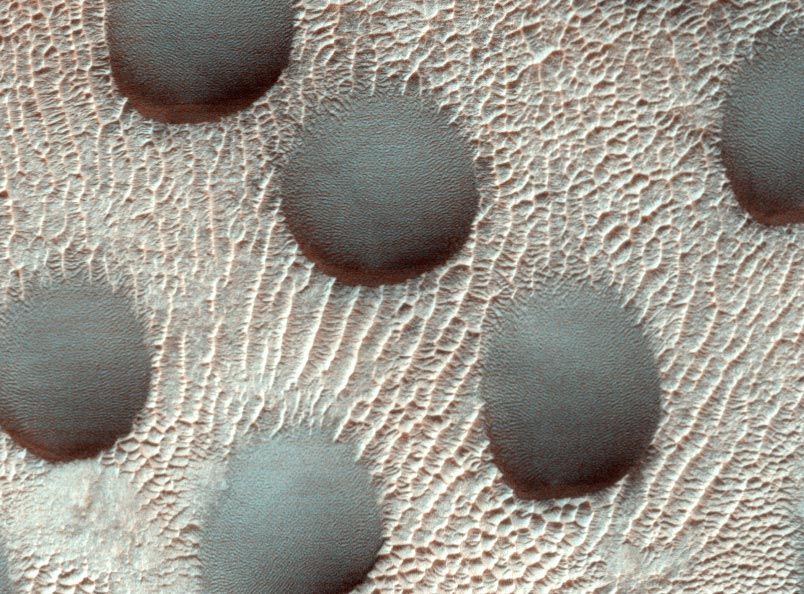
I like the round things...

 ,,,including the ones on Mars. The Mars Reconnaissance Orbiter spotted some perfectly circular sand dunes on Mars. Okay, they're a little steeper on the south side, telling us which way the wind goes.

No, we don't know what quirk of local weather is making round dunes, but check this out.


https://scitechdaily.com/strange-circular-sand-dunes-discovered-on-mars-by-nasa-spacecraft/

Tuesday, March 14, 2023

Do you have your Pi?

It's pie day, so you'd better have pie. Any kind will do. Including pizza pie.

Pi Day was founded by a museum employee and physicist named Larry Shaw in San Francisco in 1988 and in addition to eating pie, you can do the pi day challenge...how many digits can you recite from memory?

I'm not even going to try, I'm a words person, not a numbers person.

But I definitely plan on pie.

Monday, March 13, 2023

Planning the first Farside Observatory

 There is a particularly fantastic piece of real estate for locating a radio telescope that's not that far away...in space terms.

It's the other side of the moon.

One of the biggest issues with Earth-based radio telescopes is interference from all the things on Earth which produce radio waves. Like, say, the break room microwave.

If you put it on the other side of the moon, then there's a lot of rock between it and all of those things. And in late 2025 we're going to try it.

It's called the Lunar Surface Electromagnetics Experiment-Night (LuSEE-Night) and will hopefully land on the far side of the moon and start to gather data we can't get through the normal interference...direct data on the early universe before stars existed. LuSEE-Night is a pathfinder mission, a proof of concept to demonstrate whether or not a farside observatory really will work.

I believe it will.

Friday, March 10, 2023

Set the date

NASA will be assigning astronauts to Artemis II on Monday, April 3. They will be announcing the assignments in a live event on NASA Television at 11am EDT. The crew will be three astronauts from NASA and one from the Canadian Space Agency.

The prime assignment is, of course, Artemis III, but I am curious to see who they will pick.

Thursday, March 9, 2023

Energy from thin air?

 Seriously?

And it may be a silver lining to two horrible diseases...tuberculosis and leprosy. A bacterium in that group can convert hydrogen into electricity. Mycobacterium smegmatis is what we call an extremophile, meaning it survives in environments that aren't hugely conducive to life. It's learned the trick to compensate for lack of nutrients.

Now we have taken its enzyme and may be able to use it to power certain very low power devices just from the air itself. This might include digital clocks and things like sensors. It could also be used in biological fuel cells to power your smartphone...or maybe your car...with just hydrogen as fuel.

But even just from the air it could be used to power small devices in inconvenient locations where changing or charging a battery is annoying. And sustainably.